Local leadership, not just well-meaning theory
Our starting point is locally led development. Organisations and communities in partner countries should have a seat at the table where decisions on funding and priorities are made, and should help determine what constitutes a successful outcome. They have long possessed the knowledge, the networks and the leadership; it is up to us to make space for this. Many organisations in our sector are already taking steps in this direction and are openly seeking ways to do things differently. At the same time, we see that agreements on what happens within a programme are largely determined by the funding; whoever pays calls the shots. Genuine localisation requires us to scrutinise those structures too, together with donors and partners, and to make tough choices, some of which may be painful for us.
More than just one point
Our vision extends beyond this single point. What we do must continue to be grounded in human rights and international law, particularly now that international cooperation is becoming increasingly transactional. And policies must not work against one another: it makes little sense to invest in development with one hand, whilst allowing trade, climate, tax or migration policies to undermine what we are trying to build with the other. In addition, we are seeking to connect with people outside our own circle, with young people, the diaspora, businesses, trade unions and research institutions, to broaden our support base. That support is by no means a given any more.
Less micromanagement, less bureaucracy
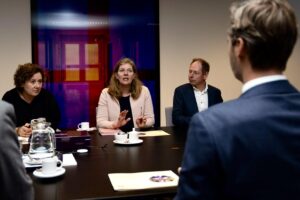
Specifically, we asked the minister, including in an email we sent on Wednesday, for two concrete things. To use funding to determine what happens in programmes to a lesser extent. And to make compliance and accountability more accessible. The latter is a plea for trust in partners in the countries where projects are carried out. The question is whether we are burdening them with an administrative burden that only large organisations can bear. Anyone who structures accountability in such a way that the smallest organisations drop out is, in effect, choosing who gets to participate.
The MFF: what is at stake
Another call we made in the email is to keep a close eye on what is currently happening in Brussels. Negotiations are now underway there on the Multiannual Financial Framework, and what is on the table is causing us and our network great concern. The Global Europe instrument is at risk of having billions of euros cut from its budget, and other programmes are also being affected, such as AgoraEU, the programme that provides a platform for civil society. This is a serious matter. We are at risk of falling below a minimum threshold in terms of civic space. And this fits into a trend in which that space is becoming increasingly restricted worldwide. Now this is also becoming apparent within the EU.
For the Minister, our vision is one of the building blocks for the debate, alongside the AIV’s vision. We appreciate that. We hope that Sjoerdsma, as a supporter of civil society organisations, will also speak out against the erosion of civic space in the MFF negotiations. It is time for the fine words about the role of civil society and (local) leadership to be translated into the corresponding choices. Partos is certainly taking up the challenge. We remain committed to Shifting the Power and to building a broad civil society movement for international cooperation in the Netherlands and across Europe.