


We greatly appreciated your presence at ‘The Next Move’ Unconference where about 200 people reimagined the future of the Dutch development sector. The debate started with a collective framing roundtable, featuring speakers from the Global Majority, donors, diaspora, youth movements, activists and NGOs, about what a truly decolonial and localised international cooperation system could look like.
We unpacked the speakers’ provocations: putting Africa truly at the centre, building truly equal partnerships and youth leadership in practice, redefining roles and approaches for donors, INGOs and other actors, and building a new, context-specific international cooperation ecosystem.
Using creative methods and the ‘Berkana two-loop model of transition’, we explored four key questions to foster a future vision of a new ecosystem. How can it be built on experiences of pioneers? What is blocking transformation in the current system? What can we leave behind? And what should we carry forward from the current development cooperation sector? In four creative breakout rooms, participants turned these questions into concrete ideas to reshape the sector.
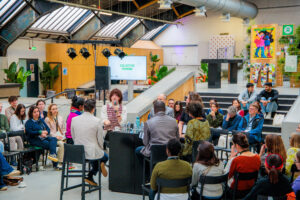
Storytelling: The future role of northern NGOs, diaspora, private sector and government
Using the power of storytelling to find new words for the future, participants emphasised the need to move from development cooperation to international cooperation. To overcome the lack of trust rooted in colonial legacies, the sector must shift power, redefine whose knowledge counts, and abandon the assumption that solutions come from the Global North. A future-proof ecosystem requires long-term horizons, space for youth climate leadership across North and South, and partnerships built on solidarity, deep listening, and co-creation.
The sector needs to redefine itself and engage a broader range of actors and partners, leaving behind the assumption that expertise and solutions mainly come from the Global North, and instead focusing on equitable forms of cooperation.

Ecosystem thinking: Alternative financing methods
Drawing lessons from natural ecosystems, where resources circulate through reciprocity and connection, participants were called to flip the current funding system. Short-term, restricted funding and heavy reporting burdens prioritise Northern donor agendas over local communities. To make localisation and decolonisation real, we must experiment with trust-based approaches. Pooling donor funds to reduce single-donor dependency, simplifying reporting, increasing downward accountability to communities, shaping financial agreements with all actors, and testing participatory grant-making mechanisms.
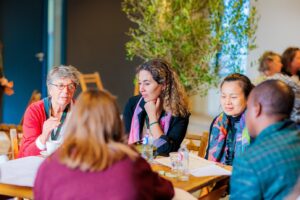
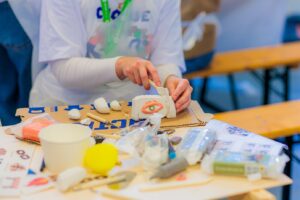
Landscape claying: Countering civic space threats
During this session, we used clay to visualise what the sector would look like when we actively defend our collective civic space. The session looked beyond shrinking budgets to threats like the tech revolution, the manosphere, and anti-rights movements. While pioneers are increasingly uniting across borders and topics, many Western organisations still rely on top-down models that undermine true partnerships. “But small together becomes big again.” Donors and INGOs can support these movements and pioneers, who are hacking the system and developing alternatives.
World Café: Movement building and citizenship
Movements today face physical and digital threats, demonisation, and one-sided media narratives. To counter this, participants called for reconnecting movements to political action. This means building on shared values and a common language, while leaving infighting and cancelling behind. Movements must listen to the broader public and create a North–South level playing field where everyone has the courage and funding to act. Achieving this requires backing diverse, visionary leaders, especially youth, women, and local leaders, and relying on trusted connectors to build coalitions of hope.
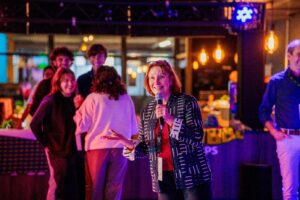
Moving forward: From insights to a Manifesto
Through collective sense-making between the breakout room participants and a final fish-bowl debate, we captured our key takeaways and proposed building blocks for a Call to Action. This will be shaped as a Manifesto, declaring the principles and practices to support a true transformation of the sector. A transformation that starts with you and your organisation and that requires other organisations in and outside the sector to join.
Oxfam Novib and PARTOS invite you to keep connected and make that Manifesto real. Sign up to this newslettre for updates on the next steps and sessions.