


The why, what and how of the tool
The webinar began with a moment of reflection, inviting participants to connect with both their body and mind. Our facilitator, Gigi, encouraged us to notice any tension we might be holding and to reflect on how we communicate, both with ourselves and with others. This served as a powerful reminder that power is not only expressed through structures and systems, but can also be felt in our bodies and shape the way we think, act, and engage with others. Gigi challenged participants with a thought-provoking question: In your communication and partnerships, how aware are you of existing power imbalances?
Building on this reflection, we turned to the practical application of the Power Awareness Tool (PAT). The tool emerged from the recognition that the international cooperation sector has traditionally been shaped by top-down structures, often placing Global North organisations and institutions in positions of greater influence. At the same time, the sector is navigating significant changes, including increasing financial and geopolitical pressures, while new and often underrepresented actors, such as diaspora organisations, Global Majority networks, youth networks, social enterprises, and more stakeholders focused on social impact, are playing an increasingly visible role.
In response to these shifts, the PAT was co-created with seven non-profit organisations as an online platform designed to support more equitable partnerships. The tool helps partners come together to discuss critical decision-making processes, examine how power and influence are distributed, and identify concrete actions to address imbalances and strengthen collaboration.
To learn more about the tool and how it can be used in practice, watch the video linked alongside this article.
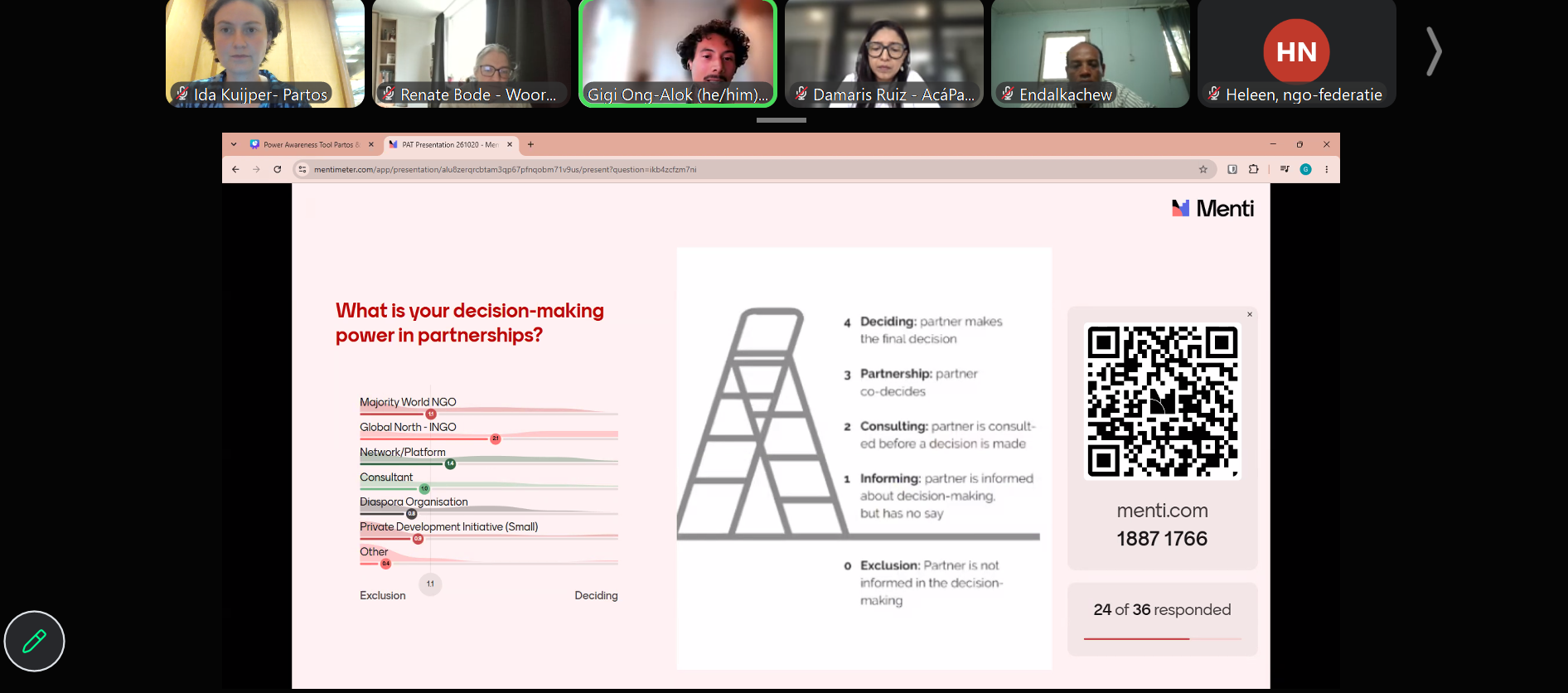
Learning from Practice
Woord en Daad and their partners, BBBC from Ethiopia and ADP from Uganda, shared their first-hand experience with the tool.
Endalkachew Bogale from BBBC in Ethiopia explained how the PAT helped consortium partners assess participation in decision-making and create space for open and honest dialogue.
The conversations enabled partners to identify gaps in participation, strengthen transparency and accountability, and agree on actions to improve collaboration. One of the most important lessons, according to Endalkachew, was the value of taking time to understand one another’s roles, expectations and responsibilities before starting the assessment.
Clear communication, broad participation and shared ownership were identified as critical factors for success.
Moses Okello from ADP Uganda shared a candid reflection on his organisation’s experience. Looking back, he felt the consortium should have used the PAT from the very beginning of the partnership.
As the collaboration progressed, uncertainty emerged around roles, leadership and decision-making responsibilities. These issues created friction but were difficult to discuss openly. Introducing the PAT created a structured opportunity to have those conversations.
The discussions surfaced opportunities for improvement, including stronger co-creation, clearer role definitions and earlier communication around budget changes and programme targets.
Last but not least, Serge Beel from 11.11.11 shared how the organisation used the PAT as part of its broader decolonisation journey.
One of the key insights was that power is often closely linked to perception. The tool helped make visible the privileges that organisations may hold through factors such as proximity to decision-making, access to resources and language. The process highlighted participation gaps, governance challenges and the tendency for strategic decisions to remain concentrated at headquarters rather than with partners closer to implementation realities. Most importantly, it created a foundation for more open and transparent conversations about how power is exercised and how it can be shifted more effectively.
Looking Beyond Participation
Closing speaker Damaris Ruiz co-president of Acapaca and director of We Effect, welcomed the PAT as an important contribution to efforts to address unequal power relations in international cooperation.
She stressed that conversations about power must go beyond participation alone. Questions about who controls resources, who sets the rules and who assumes risks remain central to creating more equitable partnerships. Global South organisations should not be viewed only as recipients of funding, she argued, but also as organisations that generate knowledge, expertise and solutions.
Damaris highlighted the importance of trust, mutual accountability and shared decision-making from the earliest stages of partnership development. Using a powerful metaphor, she suggested that equitable partnerships require not only more people at the table, but sometimes the creation of an entirely new table where Global Majority actors, those most closely affected by decision-making, decide what is on the menu and how it is served.
Conclusion
Throughout the webinar, a common message emerged: addressing power imbalances is not a one-off exercise, but an ongoing process of reflection, dialogue and adaptation.
Moving forward, Partos will use the valuable insights, perspectives and feedback gathered during the webinar to further review and strengthen the Power Awareness Tool. As part of its Equitable Partnerships track, Partos, together with co-host of the tool Ngo-federatie, remain committed to advancing the use of the tool and fostering more equitable partnerships across the sector. More updates will follow soon.