


Opening remarks: current state of LLD
In her opening remarks, Charlotte Divin of Peace Direct highlighted how discussions on locally-led development, shifting power, humanitarian action and peacebuilding often take place in separate spaces, despite facing many of the same challenges. Referring to the OECD DAC Guidelines on Locally-Led Development and the Call to Action, she stressed the importance of bringing together NGOs, donors, governments, foundations and local actors to move beyond sectoral silos and turn commitments into practice. With over 220 signatories, the Call to Action reflects growing momentum behind this agenda. At the same time, Charlotte emphasized that locally-led development is already happening; the challenge is whether the wider sector is willing to adapt its systems, partnerships and practices to support local leadership.
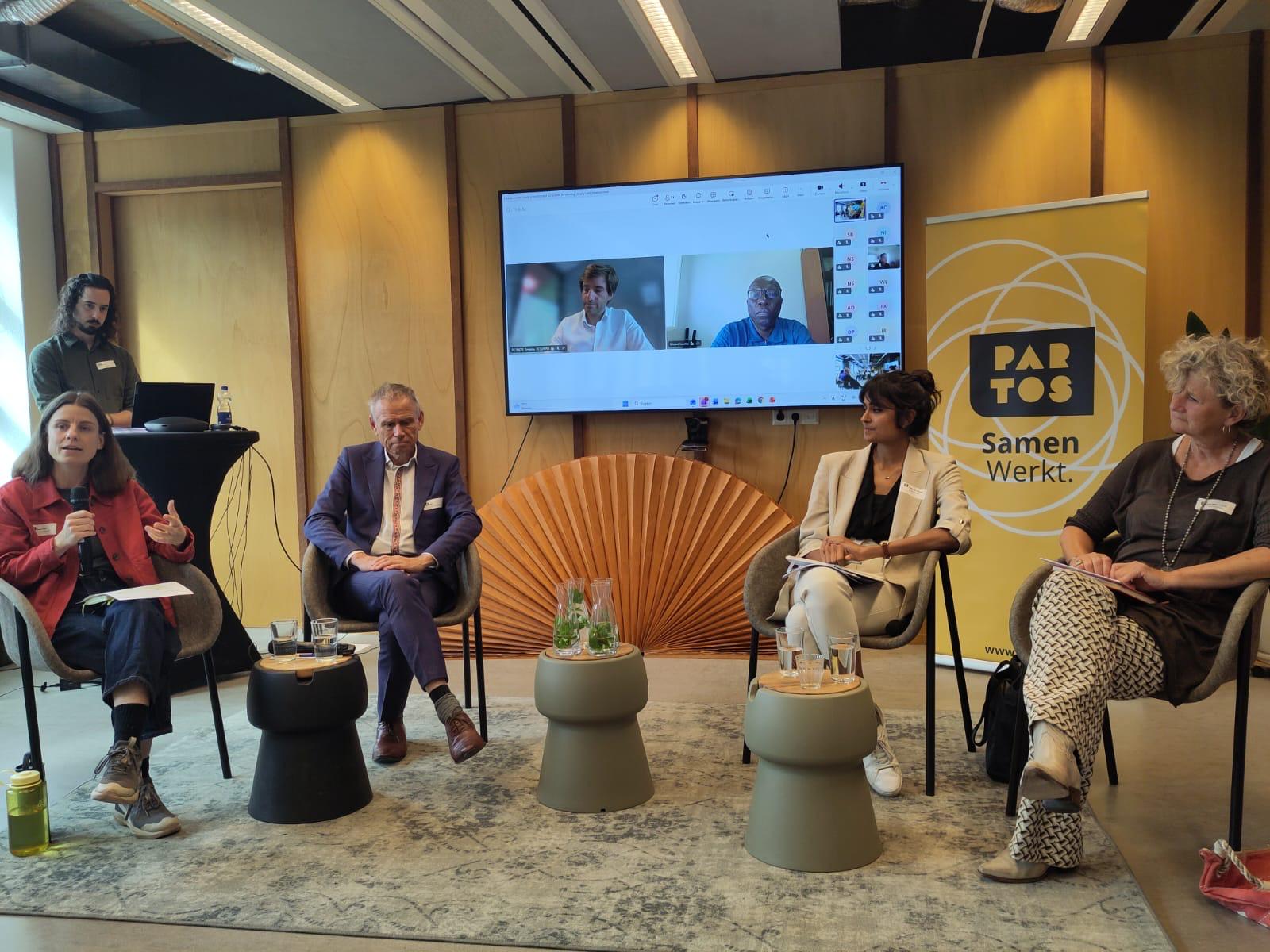
The panel conversation
A key contribution came from Moses Isooba, Executive Director of NGO Forum Uganda, who argued that locally-led development begins with a shift in our perception of the role of local actors. Rather than viewing local actors as beneficiaries, he described them as co-investors who bring knowledge, resources, relationships and leadership to development processes. According to Moses, genuine locally-led development requires more than local implementation. It raises fundamental questions about who controls resources, who makes decisions and who defines success. Without these shifts, localisation risks becoming little more than subcontracting.
Gregory de Paepe, co-author of the OECD guidelines, stressed that the guidelines do not introduce new ideas but bring together lessons and practices that many organisations have already been implementing. He emphasised that locally-led development is not only about funding flows, but about agency, leadership and power. While large-scale system change can be difficult in a context of shrinking aid budgets and political pressures, he also pointed to practical actions organisations can take today, such as simplifying funding procedures, using local languages and improving co-creation processes.
Representing the Dutch Ministry of Foreign Affairs, Laurent Umans shared how the Netherlands is working to operationalise its commitments as a signatory of the Call to Action. Recent policy guidance places greater emphasis on country-led and locally-led approaches, while encouraging a shift from traditional donor-recipient relationships towards partnerships based on mutual benefit and co-financing. At the same time, he acknowledged that while promising examples already exist, broader systems change is still needed.
Deepa Nambiar, Director of Pledge for Change, reflected on the role of international NGOs in enabling locally-led development. Through the Pledge for Change accountability mechanism, INGOs and local organisations jointly assess progress on commitments around equitable partnerships and shifting power. While positive steps are being made, Deepa noted that progress remains uneven and that policy changes do not automatically result in meaningful shifts in decision-making power. She encouraged organisations to focus not only on donor constraints, but also on the areas where they have the ability to act now, from co-designing programmes to advocating for different funding practices.
Closing the panel, Sandra Kloezen of Fred Foundation reflected on experiences from the philanthropic sector. Discussions within the Dutch association of foundations (FIN) have increasingly focused on trust-based giving, unrestricted funding and locally-led development. While private foundations may have greater flexibility than many institutional donors, power imbalances remain a persistent challenge. Building more equitable partnerships requires not only changes in funding mechanisms, but also deeper cultural change and greater trust.
Conclusion
Throughout the discussion, a common message emerged: locally-led development is not a future aspiration. It is already happening in communities around the world. The challenge is whether international actors are willing to adapt their systems, practices and partnerships to support and strengthen that leadership. Participants repeatedly stressed the importance of moving beyond rhetoric and commitments towards practical action, while recognising that meaningful change takes time.
As Moses Isooba reminded the audience through a Dutch proverb:“Trust comes on foot, but leaves on horseback.” Building trust, shifting power and changing systems are long-term processes that require patience, persistence and accountability. Yet the conversation and various resources mentioned, also highlighted that there are many concrete actions organisations can take today.
Through its Equitable Partnerships track, Partos will continue to facilitate dialogue, learning and exchange on locally-led development and shifting power. By connecting networks, sectors and organisations that are often engaged in these conversations separately, we aim to build bridges across silos and strengthen collective action. Ultimately, our ambition is to support the transition towards an international cooperation system that is rooted in equity, driven by local leadership, and responsive to the priorities and aspirations of communities themselves.