


Guiding us through the Guide
Lysanne opened the event by explaining the journey behind the Guide. Her work on this topic began long before the publication itself. As Generative AI-use became rapidly more widespread and normalised, she recognized the need for a more critical conversation about its use in our sector. This led her to start sharing her questions, concerns, and reflections online.
As project lead of the AI Guide, Lysanne explored these questions more deeply and realised how difficult this subject is within a sector that prides itself on its morals and values. One conversation with the director of an INGO in particular captured a sentiment shared by many organisations. During a meeting this director attended the ethical risks of AI were discussed, followed by an uncomfortable silence before someone finally asked: “We are still going to use it, right?”
This example became the red thread behind Lysanne’s research. She set out to answer the question: If we are going to use it as NGOs, then how? Can we even use it responsibly?
The Guide begins with the foundation of that search: understanding what AI actually is. Before organisations can make informed decisions about AI, they first need a clear understanding of the technology itself. The Guide’s answer to this question is based on the lens through which you perceive AI, as a techno-optimist or an anti-capitalist for example.
When it comes to organisational structures for AI-use in the workplace, Lysanne emphasised that an infrastructure needs to be built with clear ownership on who handles AI policy, working groups, moral deliberations and more within the organisation. The Guide goes deeper into different infrastructures to fit your organisational needs.
The presentation ended with Lysanne underlining the importance of organisations to build digital resilience and autonomy. Especially in a time of increased cyber attacks. She concluded that a movement is needed within the sector to step away from Big Tech and move towards alternatives to build resilient digital infrastructures. Such alternatives are also mentioned in the Guide.
SOMO and the Big Tech lobby playbook
To build on Lysanne’s call to action, Thijs presented the acceptances we need to have when using Generative AI. These include accepting environmental costs, more power to Big Tech companies, using data labeled by exploited workers and more.
The Big Tech lobby playbook is a series of articles that delve into how Big Tech companies, think of Nvidia for example, are controlling the narrative and exerting power on AI. Thijs mentioned that these companies are able to do so through, amongst other strategies,:
- Endless lobbying (and having the means to do so)
- The ability and means to create an echo chamber (through think tanks, academia, astroturfing and network of amplifiers)
- Controlling the narrative on AI by making it seem like there are no alternatives.
The playbook aims to research and uncover the tools and tactics of Big Tech’s global influence over law and policymaking. It helps organisations critically assess the AI solutions they adopt and recognise their dependencies on large technology providers. An exploration of alternative, open-source technologies is therefore promoted. By understanding how power is concentrated within the AI ecosystem, organisations can make more informed choices that align with their values, strengthen their digital sovereignty and contribute to a more diverse and transparent digital infrastructure.
Interactive discussion & conclusion
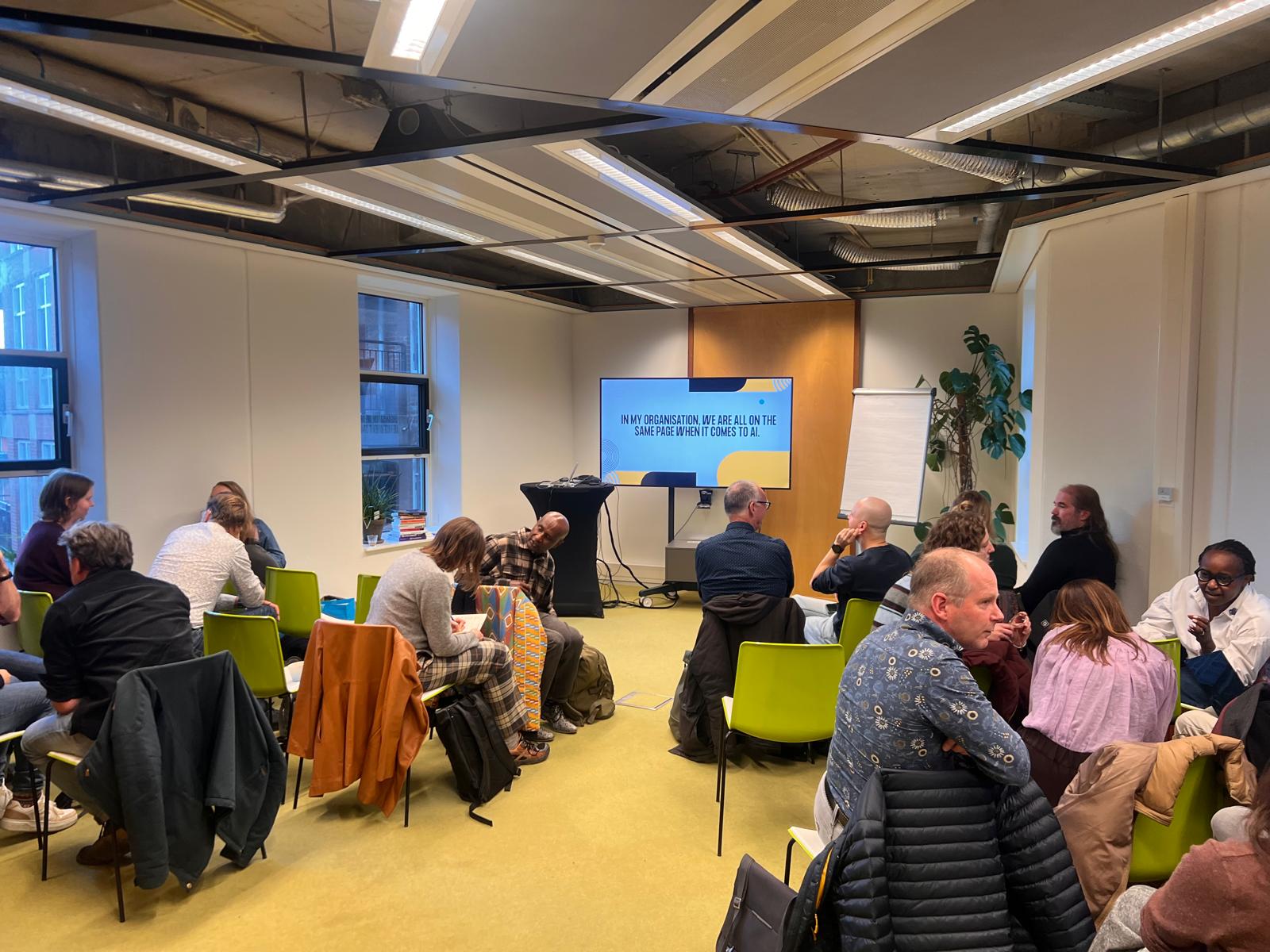
What followed from these presentations was an active discussion with participants as the following statements were discussed in groups:
- In my organisation we are all on the same page when it comes to AI.
- This is how I perceive AI to be changing the context and content of our work… (fill in).
- I’d love to consider switching to European, sovereign alternatives. (But…).
Many participants noted that perceptions and use of AI differ greatly within their organisations. This creates a risk of shadow AI, where employees use AI tools, applications, or agents without the knowledge or approval of the organization or its IT department. Increasing AI literacy was seen as a key way to mitigate this risk. Increased awareness of the consequences of AI use, including environmental impacts and data privacy breaches and concerns, can encourage more responsible and informed use of these technologies. To conclude, participants emphasised the importance of sharing knowledge and keeping one another informed about rapidly evolving AI developments. As the technology continues to advance at pace, collaboration across the sector will be essential to build digital resilience.