


Youth as a pillar of innovation continuity and hope, not an accessory
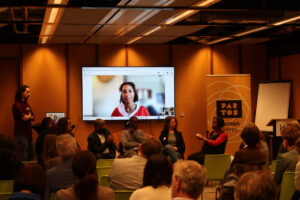
The conversation started by talking to youth representatives. The first speaker welcomed to the stage was Helena Szczupak, Brazilian-Portuguese international human rights and humanitarian lawyer and currently a consultant, advising Partos on youth participation within Partos. She opened the discussion by challenging how the sector views young people and what the definition of youth is. Youth is a very diverse group with a lot of age diversity and global diversity. Treating youth as a homogeneous group or an “accessory” to your organisation is not the way. A structural place for youth in your organisation is a pillar of innovation, hope and continuity. Especially since young people make up a massive share of the populations international cooperation serves, they should have a voice.
According to Helena, the sector needs to relearn a vital skill that stems from youth. The courage to never stop asking ourselves why. Why can’t I have another piece of chocolate? Why is the sky blue? Why does the system of international cooperation look like this? This is not about innocence or naivety.
“To ask why things are the way they are is an expertise.” Helena Szczupak
Diaspora bridging both worlds
Georgina Kwakye is the founder of Local Changemakers and has been working with diaspora organisations for 20 years. Georgina is inspired by her father, who used his medical education in the Netherlands to set up healthcare projects in his Ghanaian birth village and build on what works in Ghana. She highlighted the unique bridge function that the diaspora play. Because they possess deep intercultural knowledge and understand both contexts, diaspora organisations are valuable partners. Georgina directly called upon NGO directors to join co-creation sessions, share knowledge, and treat diaspora groups as equal partners.
Moving Beyond Tokenism and “Shiny” Representation
The next person joining the conversation is Olaoluwa (Ola) Abagun. Ola is a Nigerian lawyer and Diversity Equity, and Inclusion expert. She called for an intersectional approach that moves past superficial inclusion. She noted that organisations often default to inviting the same “shiny” young people, those with prestigious degrees, fluent in English, and no (visible or invisible) disabilities. Instead, Ola would ask organisations to focus on creating genuine belonging for a diverse group of voices and engage with unusual suspects.
“Young people should be at the table beyond the topic of representation.” — Olaoluwa Abagun
Quoting an African proverb, “The elderly person knows the way to the well, but it is the young person who brings the strength to dig deeper”, Ola explained that inclusion isn’t about older generations losing power, but about mutual learning. Both generations bring their own knowledge, experiences, and perspectives to the table, but we need to create a space where young people can also influence decisions.
The urgency of youth participation in the international cooperation sector
Channelijne (Chan) Hulshof, a development professional working at the intersection of global health, research, and strategy at GOAL 3, underscored the urgency of the moment. As a young professional she has very different lived experiences than her colleagues or even people of her own age. But the “older” people in the room probably struggled with the same struggles when entering the sector as some young people now. The difference is that young professionals now don’t have 20 years or so to wait for executive positions. We see a world unfolding with global crises, and it feels like young people are sitting on the sidelines. Chan urged directors to remember what guidance they wished they had when starting out and to provide this guidance. Young people should receive chances to be able to make decisions and should not stay outside or have to keep trying things from the outside.
“The world is dying and you need our help”
Chan is a mentor herself and provides guidance to people, even if she is a young person herself. She asked the people in the room to be more open and proactive. To keep sharing perspectives and experiences with others. Reach out to youth, reach out to diaspora and listen to them.
Trust and transparency
Uzoamaka (Uzo) Klein Leugemors-Ezeunala, Chairperson of Stichting Rural Women Foundation (RWF) in the Netherlands reflected on her personal journey, growing up in poverty in Nigeria before moving to the Netherlands more than three decades ago. Drawing on her experience of living and working in both countries, she highlighted the value of understanding different contexts including the challenges and opportunities involved in building partnerships between communities in Nigeria and organisations in the Netherlands.
Uzo also spoke about the importance of trust in building and sustaining diaspora-led initiatives. She noted that working with people who are personally known to you, including family members, can sometimes raise questions about potential conflicts of interest. However, she explained that personal trust and professional accountability should not be seen as opposing principles. What matters is that relationships are managed transparently, responsibilities are clearly defined and appropriate procedures are followed. For her, trust is an important foundation for effective collaboration while transparency and accountability help sustain that trust.
“I can share what I know and the experiences I have had,” Uzo said.
Her message to decision-makers and organisations working in international development was clear: diaspora communities have valuable knowledge, experience and connections that should be recognised and included in decision-making. She encouraged those in positions of influence to invite diaspora representatives to the table, listen to their perspectives and create opportunities for meaningful engagement. Uzo expressed her willingness to share her experience and to remain open to conversations, partnerships and new collaborations.
From local ideas to entrepreneurship
Finally, we invited Abdisalam Ali, the Chair of Stichting Kaalo Nederland (SKN), to the conversation. He shared how his organisation starts innovative and sustainable projects in Somalia, where 75% of the population is under 30. By sharing concrete examples of his projects, Abdisalam illustrated what happens when you invest in local potential. In Somalia, there is a lot of camel milk, but people don’t have a way to store or refrigerate it. It spoiled quickly and could not create a steady income. SKN helped open a shop with refrigerators to keep the milk cold and distribute it into the city. As a result, local herders were able to turn their products into a business and became entrepreneurs.
But where do Abdisalam’s ideas come from? People in Somalia come up with countless ideas. Abdisalam analyses the ideas to see what is feasible, who is trustworthy, and which initiatives have the highest chance of success. Project ideas always emerge locally, and the local community must become the owner of the project, for it to succeed.
“I think in power, but you reminded me it is about togetherness” – Kiza
A call to action and sinking ship
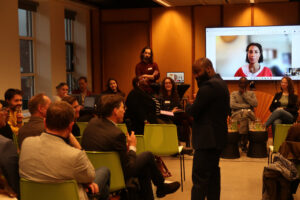
When the discussion opened to the audience, the conversation shifted to how these insights translate to daily life and why real change often stalls. Participants noted that traditional policymaking requires leaders to talk less and listen more, creating genuine space for grassroots organisations and seeing young people as active drivers of change.
Several attendees voiced a mix of urgency and frustration. Young people have spoken up in countless forums, yet too often nothing changes. True inclusion requires bringing youth in at the very start of a process. As one participant put it, while youth are sometimes dismissed as “naive,” that perspective is actually a strength. It brings the courage not just to dig deeper in the existing well, but to dig next to the well and try something entirely new. Of course, sharing power causes discomfort. People rarely give up power willingly, but if there is no discomfort in the room, it is a sign that the team still lacks real diversity.
The discussion took a turn when one participant compared the international cooperation sector to the Titanic. Arguing that the sector is facing shrinking budgets, declining public support, rigid siloed structures, and clinging to old models. There will be no seat at a sinking table, a new table is needed.
Closing Takeaways
After wrapping up the discussion with the audience, Kiza Magendane reflected on the emotional side of systemic change. Before building something new, the sector must first accept reality as it is and recognise that some old ways of working need to be let go. A process much like grief work. From there, the speakers shared their final calls to action.
Helena’s takeaway: embrace idealism and “naivety”. When the current system is failing, questioning the status quo isn’t unrealistic, it is essential, and young people deserve actual decision-making power in shaping what comes next.
Georgina’s message: don’t overlook the diaspora. While several directors engaged with the topic of youth during the session, only one spoke up about diaspora collaboration, highlighting a major blind spot. Diaspora communities hold deep connections to both worlds, bring knowledge, and are ready to collaborate.