


Women are active protagonists in the peace-building processes
In Colombia, sociopolitical violence has left deep scars on the lives of women and their communities, especially in the areas most affected by armed conflict. Yet far from confining themselves to the role of victims, women have been active protagonists in the peace-building processes in the country. Following the signing of the Havana Peace Agreement in 2016, which incorporated specific gender measures, women leaders and human rights defenders have redoubled their efforts to ensure its implementation and to make society understand that peace goes beyond a document and the laying down of arms: it is a living process that requires real transformations in the territories.
Comprehensive approach
Faced with this reality, and drawing on the experience of the consortium’s five partner organisations, the Women Advocating for Peace (WAP) programme has accompanied social leaders, human rights defenders, and their organisations, strengthening their advocacy in diverse decision-making spaces related to peacebuilding and gender equality. With a comprehensive approach that integrates the psychosocial, political, and economic dimensions, the consortium has contributed to creating favourable conditions for expanding women’s participation, influence, and leadership in peacebuilding scenarios at the local, territorial, and national levels.
Working in a consortium strengthened the transformative role of women
Working in a consortium not only meant joining forces but also building collective strength capable of achieving what no organisation could have accomplished on its own. The combination of our trajectories, knowledge, and methodologies expanded our capacity for action and opened the possibility of reaching more women, with greater scope and impact. This synergy strengthened the transformative role of women in their diversity. This encourages their political participation with stronger skills, promotes lives free from violence and with psychosocial well-being and contributes to their economic autonomy as a pillar of sustainable peace.
WAP strengthened the capacities of 2,700 women to lead peacebuilding processes
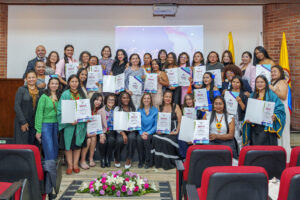
Specifically, the WAP programme supported more than 2,700 women in six departments of Colombia, facilitating their capacities to lead peacebuilding processes, strengthen their protection and self-protection, and advance towards economic autonomy. In the political sphere, 38 women ran for elected office in the 2023 territorial elections, and 13 were elected, setting a historic precedent for women’s political participation in their communities. On the economic front, the programme helped strengthen 24 women-led productive initiatives and promoted networks such as the National Network of Indigenous Women, which today have a sustained impact on local and national public policies.
Feminist foreign policy
This collective work contributed to achievements at the national level: Colombia adopted its first National Action Plan for UN Security Council Resolution 1325 on Women, Peace, and Security and formulated its first feminist foreign policy. Also, through the consortium, we have monitored the implementation of the gender measures of the Peace Agreement. Likewise, the proposals of the women participating in the programme were incorporated into 17 territorial development plans and the National Development Plan.
The combination of a constant territorial presence, strategic alliances, and a comprehensive approach—which included psychosocial and psychocultural support for more than 2,800 women and the sensitisation of 421 men to transform gender norms—has made the progress achieved sustainable. This model has left a lasting mark on the territories and stands as a replicable reference for strengthening the Women, Peace, and Security agenda in other contexts.
Implementing the WAP programme has yielded many insights, underscoring that advocacy is more powerful when built on multiple levels: connecting the local, national, and international spheres so that women’s voices are heard in all decision-making spaces. Also, it is not just about specific actions, but about sustained processes that strengthen capacities, build trust, and consolidate support networks among women and organisations.
Another lesson has been the importance of a comprehensive approach: combining political work with psychosocial and psychocultural support and the strengthening of economic autonomy of women multiplies the impact and ensures that progress is lasting. Furthermore, experience has shown that working in partnership—pooling knowledge and resources—is more transformative than acting alone.
This path leaves us with one certainty: when women organise, care for each other, and act together, they can shift structures and open paths to making peace and gender equality a reality in their territories.