


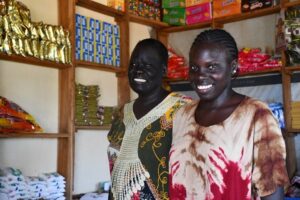
Cover picture: Akuch in her shop, happily attending to her customers
The story of Akuch Deng
When Akuch Deng lost her sight at 22, her first thought was for her children. She was afraid she would face discrimination because of her disability.
“When my blindness began, I was worried about not having the means to educate my children,” she said.
In Jonglei State and across the country, persons with disabilities have long been marginalised and excluded from public life. Their access to land, food, education, and livelihoods is severely limited due to both structural and attitudinal barriers. Although the UN Convention on the Rights of Persons with Disabilities (UNCRPD) provides a global legal framework for inclusive development, South Sudan only ratified it in 2023. Before then, national commitment to inclusion was weak, and local authorities lacked the tools and awareness to promote disability rights.
The We Are Able! (WaA!) programme sought to change this by focusing on three pathways of transformation:
- Community Mobilisation: Empowering persons with disabilities to amplify their voices and advocate for their rights.
- Strengthening Civil Society and Organisations for Persons with Disabilities (OPDs): Building the institutional and technical capacity of organisations that represent persons with disabilities.
- Engaging Public Authorities: Working with local and national governments to create inclusive legal and policy environments.
Improving security and equitable access to land and services in South Sudan
Through these pathways, WaA! has helped improve food security and equitable access to land and services in South Sudan. It supported the South Sudan Union of Persons with Disabilities (SSUPD) to increase its legitimacy, internal coordination, and national influence. Simultaneously, local OPDs were strengthened to mobilise their constituencies and engage decision-makers. Using the Local Inclusion Agenda model, OPDs and local authorities co-created inclusive policies and planning processes. This led to the establishment of Disability Mainstreaming Committees (DMCs) in local governments to institutionalise inclusive decision-making. These efforts have led to lasting national impacts. In 2024, the National Action Plan for the UNCRPD was finalised, addressing cultural and structural barriers to inclusion. The Disability Bill was also developed and validated, laying the legal foundation for rights-based programming. Most significantly, SSUPD secured a seat on the National Election Commission, a milestone for political inclusion.
“The environment was not supportive for persons with disabilities, and my opportunities were limited.” – Alith Amer Pandair
Local stories of transformation
These national shifts are grounded in local stories of transformation: Alith Amer Pandair, 19, from Konbek Boma in Makuach Payam, Bor County, was born with a physical disability and had no access to education growing up. “The environment was not supportive for persons with disabilities, and my opportunities were limited,” she said.
That changed when the WaA! project reached her area. The LIA small grants scheme supported her to resume her education, starting from Primary 8 at Good Shepherd Primary School, and now she is attending Amazing Grace Secondary School in Bor. She receives learning materials and continuous support, while the programme works with schools and community leaders to foster inclusion. “While I still face daily challenges like walking to school without a wheelchair or sleeping without a mattress, the project helped me stay focused. I even participate in school debates and write poetry. These activities give me confidence and allow me to express myself,” Alith shared.
Her story shows the ripple effects of inclusion. Schools are becoming more accessible and more children with disabilities are enrolling. Still, Alith advocates for further progress: “If ramps were built in every school, many challenges would be reduced.”
Business skills for the future
Alith and Akuch are among hundreds of individuals whose lives have been changed by the WaA! programme. Akuch, now 50, enrolled in business skills training and started a small shop. “Now that we have businesses, we are respected in the community regardless of our disabilities. My children are in school, and I feel equal in the community,” she said.
“If you give someone a chance, especially someone with a disability, they can grow, contribute, and inspire others.”- Alith Amer Pandair
These stories reflect a broader lesson: local transformation fuels national change. By enabling persons with disabilities to organise through OPDs and engage local authorities, WaA! has created a model for inclusive governance and development. The presence of DMCs and strengthened OPDs means disability inclusion is now a permanent agenda item at both local and national levels.
Even as the WaA! programme concludes, its impact lives on. As Alith puts it, “If you give someone a chance, especially someone with a disability, they can grow, contribute, and inspire others.”