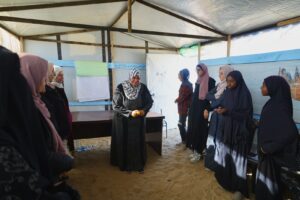


“When you walk into a storm for the sake of women’s rights, you learn that cultural and social resistance is not a wall but a door—one that opens slowly, with patience, trust, and the courage to keep knocking.”
Fatimeh Abu Kutleh, founder of the Banat Al-Reef Society.
Establishing a Lifeline for Marginalised Women
Since 1961, Nahdeit Banat Al-Reef Charitable Society has been a fixture in Dura, a city south of Hebron in the West Bank. It provides health services, emergency response, and mental health and psychosocial support to a population facing structural marginalisation. In 2021, through the We Rise Consortium, the society partnered with the Women’s Centre for Legal Aid and Counselling (WCLAC) to establish a legal and social counselling unit for women—services rarely available in this conservative area. From 2021 to 2025, WCLAC has been part of the We Rise Consortium in Occupied Palestinian Territory.
The initiative faced significant resistance. Many in the community argued these services would dismantle “healthy” family dynamics, encourage women to challenge their spouses, and expose private matters. Some dismissed the need entirely, claiming such issues did not exist in Palestinian society. Internally, the society’s leadership feared reputational damage, loss of community trust, and even closure under public pressure.
Leadership proved decisive. Guided by its chair, Fatimeh Abu Kutleh, whose commitment to supporting marginalised women outweighed the risks, Banat Al-Reef worked with WCLAC to assess potential threats and design mitigation strategies. They leveraged a long-standing partnership with Al-Dura municipality, engaging municipal leaders and other influential figures early on to publicly endorse the initiative and shield it from backlash.
Integrating Services and Shifting Attitudes
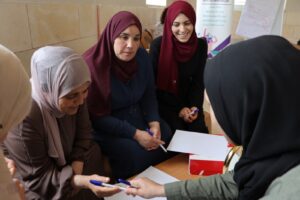
The approach was deliberately integrated. The counselling unit was embedded within Banat Al-Reef’s existing programming, presented as a natural extension of its mission rather than a standalone project. WCLAC played a pivotal role, providing technical expertise, staff training, and quality assurance. Delivering services with discretion and professionalism was central to building community trust.
Initial uptake was slow, as women feared exposure or gossip. Over time, the discreet case-handling, the society’s decades of credibility, and integration into familiar services encouraged participation. By the end of 2024, 587 women from Dura and neighbouring marginalised villages had accessed the counselling unit. Cases included legal guidance on alimony and custody, litigation support, domestic violence protection, and individual or group psychosocial counselling. In many situations, both spouses participated, turning this into a place for constructive resolution rather than conflict escalation.
Community attitudes shifted noticeably. What had been framed as a disruptive idea came to be seen as an essential service, one that Banat Al-Reef is committed to maintaining.
Sustaining Change and Lessons for Practitioners
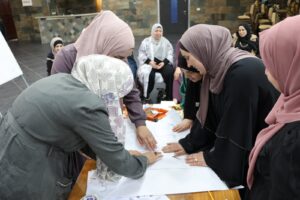
From the start, sustainability was a priority. The counselling unit operates within the society’s permanent structure, ensuring continuity beyond the project’s lifespan. Staff trained by WCLAC can independently maintain and adapt services. Municipal alliances continue to provide political cover, while years of community service protect the unit’s legitimacy. Local ownership has transformed the initiative from an external project into a community-led effort.
This experience offers clear lessons for practitioners. Credible local actors are indispensable in overcoming resistance; external expertise alone cannot shift entrenched attitudes. Early engagement of community gatekeepers secures both permission and active champions for change. Integrating new services into established, trusted structures reduces perceptions of disruption, and delivering these to high professional standards builds trust that safeguards long-term sustainability.
The collaboration between Banat Al-Reef and WCLAC demonstrates how strategic partnership, sustained local leadership, and consistent trust-building can expand access to essential services for women and shift community perceptions, even in highly conservative settings. What began as a contested initiative is now a locally owned and embedded service, illustrating that, with the right approach, entrenched resistance can give way to acceptance and long-term institutional change.