


Neneh strategy
The day started off with a touching speech from Neneh Rugiatu Turay-Koroma, a Sierra-Leone based human rights campaigner and director of N’ninkie, reflecting on the ‘Neneh strategy’. This is a locally led approach, launched in 2019, which protects local culture and knowledge and works from within. Capitalizing on all the knowledge that already exists within a community.
“Despite it’ success, I still face challenges in getting funding. Every conversation every proposal I am required to change my narrative. To fit into the logic of the Global North.” – Neneh Rugiatu Turay
Within the session three break-out workshops were facilitated by N’NINKIE on ‘Reframing Western Narratives on social-work and education’, by Peace Direct on ‘INGO practices to walk the talk’ and by Raci on ‘Global South perspectives on reimagining aid’.
Global South Perspectives on Reimagining Aid
RACI’s breakout session sparked a lively and urgent conversation about how dominant narratives, often shaped through a Global North lens, continue to influence the way civil society is seen, funded, and engaged across the globe. Participants unpacked civil society is still often depicted as passive recipients of support and not as centres of expertise and decision-making. These narratives oversimplify realities and reinforce unequal power dynamics.
Participants pointed out that they are often aimed at donors, policymakers, or the public in the Global North, with messaging designed to generate legitimacy, urgency, or funding, sometimes at the expense of complexity or balanced representation.
Through collaborative visual mapping, participants examined how these narratives shape relationships and actions between local actors and donors. The session underscored the need to shift toward narratives that recognize the leadership, expertise, and agency of local civil society and that foster more equitable and trust-based partnerships.
Concluding that civil society must broaden the range of actors it reaches, ensuring more stakeholders truly understand the strategic and democratic value of organized civil society. Only by expanding this audience and reshaping the narrative can the sector strengthen solidarity, shift power, and make the case for civil society as an essential force in defending and advancing democracy.
“If stories shape systems, then shifting the story is one of our most powerful tools for transformation.” – Participant
Reframing Western Narratives in Social Work Education
N’NINKIE questioned the persistent dominance of Western theories within social work education in the Global South. The session explored how these externally derived frameworks often fail to align with the lived realities, social structures, and cultural logics of communities in Sub-Saharan Africa, with specific attention to Sierra Leone.
Grounded in N’NINKIE’s commitment to indigenous social work approaches, the activity positioned local knowledge, community agency, and culturally rooted epistemologies as essential components for developing more contextually relevant social work theory and practice.
The discussions were structured around two core questions:
- How can social work theories emerge from the socio-cultural norms and lived experiences of the Global South?
- What institutional roles and responsibilities are required to shape educational models that reflect these realities?
The dialogue across three groups converged around three overarching themes, each highlighting a distinct area of innovation essential to reframing Western narratives within the field.
Participants underscored the need for social work theories to originate from within the cultural, social, and historical contexts of the communities they aim to serve. Secondly the need for methodological approaches that are ethically responsive, inclusive, and grounded in local value systems was emphasized. Lastly participants highlighted the need for accessibility, not only of outputs but of the research process itself, as foundational to decolonizing social work education.
The session facilitated a shared understanding: Reframing Western narratives in social work requires a deliberate shift toward epistemologies, methodologies, and institutional structures grounded in local knowledge and community agency. This approach not only challenges the hegemony of Western theories but also unlocks significant potential for more sustainable, culturally relevant, and socially transformative models of development and social work practice in the Global South.
Beyond reimagining, what is within our power to think and do differently.
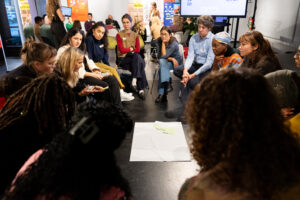
In their workshop Peace Direct opened the reflection to explore what it requires to ‘live’ and ‘act’ collaboration and decolonisation principles within our own organisation. The core question of this session was “Beyond ‘re-imagining’ what is within our power to think and do differently?’ What small steps can we take to bring ourselves closer to decolonising INGOs.
Through a fictitious scenario of an organisation committed to decolonisation, participants were challenged to take a decision that brings tension to their business model, values and realities of a system that privileges Northern organisations. In this case, the organisation had to choose if they wanted to receive funding from an inflexible donor or forward their partner as a direct grantee, surpassing the INGO’s role as intermediary grant maker. Quickly, the scenario unveiled the friction between different organisational strategies (business vs decolonisation) and the assumptions and values that drive these decisions. It showed that INGOs can create space and access to funding streams for local organisations, but it requires taking steps back to balance equity, and centre mutual trust, flexibility and co-creation. In a changing landscape, these conversations provided necessary reflections on the roles of INGOs as intermediary agents between donors and local civil society. Peace Direct is a living example of an INGO that re-imagined its relationship and role in the global aid infrastructure.
Their new publication “co-creating a global movement” offers practical and transferable learning for anyone seeking to build meaningful, equitable partnerships with local peacebuilders and changemakers.
“If we succeed in focusing community led and directly connected to donors what happens to ngo’s?” – Participant
Want to learn more?
Partos has developed many valuable resources to accelerate the transformation towards a more equitable, inclusive and decolonial system of international solidarity. Ranging from global research on the perceptions of shifting power efforts, to a practical tool to assess power(imbalances) in partnerships. Find the resources here