


The DEI trajectory
The past three years, Partos embarked on a journey to centralise Diversity, Equity and Inclusion (DEI) within the sector. The DEI trajectory was used as a key approach to accelerate social justice, decolonisation, anti-discrimination and inclusive transformation in civil society organisations. The trajectory was dedicated to DEI advocates as well as all other professionals who believe in DEI and actively want to make their organisation more inclusive and just.
Together, we have explored how exclusion and racism are still visible within our organisations, and how we can take intentional, collective steps to dismantle them. In the current climate where all human rights are under pressure, it is more important than ever to unite and put DEI on the forefront. Three years of this collective reflection and work is tied together in the Partos DEI handbook, which is shortly introduced at the end of this article and will be published soon!
The State of DEI: Insights from Camilla Ramos
Camila Ramos, Global DEI Change Manager at Hivos, shared a broader perspective on the current landscape of DEI, especially as we look beyond 2025. Camilla reminded us that while DEI is facing increasing pushback globally, these challenges are not new. Understanding the historical cycles of resistance and regression helps us to respond more strategically and stay rooted in our goal.
She encouraged us to reflect on the backbone of our DEI initiatives by asking critical questions:
- Are our values and strategies clear?
- Are we embedding DEI into our organizational strategy, funding models, and performance evaluation systems?
- Are we building cross-movement, intersectional alliances rather than remaining in our own echo chambers?
Her message is clear: to sustain DEI work in turbulent times, we must strengthen our foundations and broaden our coalitions.
From Insight to Action: An Interactive Exploration
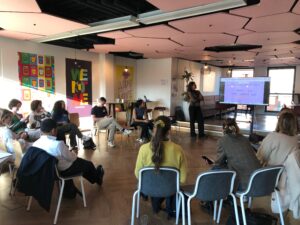
The collective reflection on the current state of DEI began with a Mentimeter exercise that encouraged participants to reflect on the challenges and opportunities of DEI within their organisation. This offered a snapshot of how these are perceived currently. One question was ‘How do I feel about DEI within my organisation in one word?’ The answers showed that an increased focus on DEI is still necessary.
After setting the scene and having a better understanding of the feelings and experiences in the room, we organised a priority-setting activity. Divided into groups, all participants had to identify one DEI non-negotiable; a principle their organisation must uphold, no matter what. This led to the following four main non-negotiables:
- Structural feedback mechanisms
Having mechanisms in place to ensure structural feedback from and for all organisational levels.
- People’s protection
Employees should be protected against discrimination and should be compensated equitably.
- Safe working space
Safe working spaces should be created, ensuring there is no discrimination, abuse, or other forms of harassment.
- Empathetic leadership
Empathetic leadership showing commitment to DEI; includes, among others, supporting mental health and pay equity.
These non-negotiables reflect the need to go back to the basics: “What gives us legitimacy?” “What systems need to be in place to guarantee and address safety & non-discrimination?” The participants were asked to individually rank these non-negotiables by placing Post-its labelled 1, 2, and 3 on the statements they found most important. This process surfaced that ‘Safe working space’ and ‘Empathetic leadership’ are seen as the two most important non-negotiables of DEI.
Diving Deeper: Uncomfortable Conversations with Elodie Kona
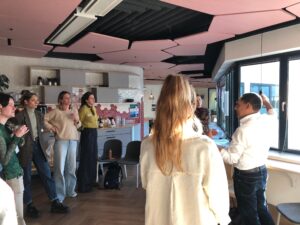
The afternoon continued with a powerful workshop led by Elodie Kona, titled Uncomfortable Conversations. Elodie is a DEI Expert and co-author of Uncomfortable Conversations as well as co-editor of the “Inclusion Marathon” and our very own “Partos DEI Handbook”. She invited us to explore what happens inside ourselves when a conversation becomes difficult, whether due to tension, vulnerability, power dynamics, or differing perspectives. She shared personal examples of moments when discomfort surfaced, helping normalise the fact that these experiences happen to all of us, even those deeply engaged in DEI work.
One of the most impactful parts of her workshop was the active listening exercise. In pairs, one person spoke for a full three minutes while the other simply listened without interrupting, no nodding toward solutions, no jumping in with personal stories. After the three minutes, they had one minute to summarise what they had heard. After which, the roles were reversed. The question guiding the exercise was simple but revealing: What makes you uncomfortable in a conversation?
For many, the exercise felt a little unnatural at first. But as the minutes passed, it became clear how grounding it can be to speak without fear of interruption and how great it is to give someone else that same space.
“The first word in a conversation is not actually a word; it is taking a breath.” – Elodie Kona
Elodie then guided us into a discussion on power relations within conversations. Someone always holds more power, whether because of role, identity, experience, or emotional state. We explored what it means to recognise who holds power at any given moment and how to navigate situations in which we either do or do not have it. This flow naturally led into a conversation about family settings, where emotions often run high and long-standing dynamics make uncomfortable conversations even more complex.
Looking Ahead: A Sneak Preview of the DEI Handbook
To close the workshop, Gigi Ong-Alok, Innovation facilitator and Inclusion lead at Partos, presented a sneak preview of the layout of the upcoming DEI Handbook. This book is a project supported by numerous people who participated in one of the events hosted as part of the trajectory. The handbook consists of concrete steps and practical frameworks towards a more just and inclusive workspace/environment. The book functions as a guide to help you with questions you might have about for example starting out with DEI work, racism in the workplace, wellbeing as a DEI practitioner and how to measure if DEI efforts are actually working and much more.
The handbook is still in development, with a graphic designer currently shaping it into a cohesive and visually engaging document. Participants were invited to browse the draft and offer feedback. Inciting excitement and curiosity, it was clear that everyone cannot wait for the final version, keep an eye out we will publish it in the coming weeks!