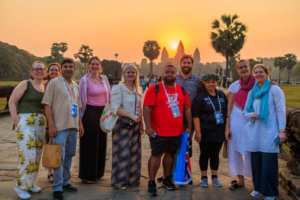

It was almost unbearable outside — the heat hit you the moment you set foot outside. Fortunately, there was good air conditioning in the conference hall in Siem Reap, which meant that discussions and conversations could get heated without anyone suffering as a result. But I must admit that it wasn’t nearly as bad as I’d feared. The week was characterised above all by a sense of togetherness and solidarity.
Over the past two years, Dutch civil society has suffered one blow after another. We are all aware of that, of course. There have been major reorganisations; organisations have merged or ceased operations altogether, and critical voices are struggling. For us, the Dutch government’s decision to withdraw funding from Partos was a major blow. As a result, we have shrunk drastically as a national platform — in size, capacity and effectiveness. Whilst our colleagues in Northern and Western Europe can still rely on structural government funding, we currently cover all our costs through membership fees.
I wondered beforehand how this would be received in a room full of international colleagues — would it ring true, or would we be an exception? I soon realised that many could relate to our situation. The pressure on civil society is being felt worldwide. Whenever someone shared a challenge, there were nods of agreement and responses. The space for civil society organisations has shrunk and actions against NGOs are on the rise.
But in Siem Reap, it also became clear that the Netherlands (along with the US) is an extreme case. The cuts here have caused a great deal of damage, and certain measures – such as the decoupling of ODA from GNI and the abolition of the feminist foreign policy – were met with raised eyebrows. Whereas other Northern and Western European platforms still receive substantial and structural support from their governments — and thus maintain a solid foundation for coordination, networking and advocacy — that foundation has been lost in our case. We are trying to do the same work, but with a fraction of the resources. The comparison gives pause for thought.
What I’m taking away from Siem Reap, therefore, is trust. Trust in Partos. Confidence in the network of civil society organisations. Not because the situation has become any easier, but because, in that conference hall, I saw what a national platform means — for its members, for the wider movement, and for the link between the local and the global. We fulfil that role too, albeit currently with fewer resources than our colleagues elsewhere.
It is precisely at a time when the scope for action is shrinking and the pressure is mounting that this role is needed more than ever. Partos’s work — coordinating, connecting, and amplifying the voice of the Dutch development sector — has not become any less relevant. On the contrary.
You will hear me emphasise this in the coming period. For example, when I had the opportunity to reflect on Minister Sjoerdsma’s speech last week, I found it easy to make this point. I knew I was supported by more than 70 colleagues worldwide. The shared experiences, the solidarity and the willingness to stand together serve as a reminder that isolation is perhaps the greatest pitfall in difficult times. The question that lingered in Siem Reap was not how we survive, but what values we take with us into the future. For me, the answer is clear: we take with us the conviction that we are stronger together and that Partos plays an indispensable role in this.