

A Divided Starting Point
In Egypt, Kenya, Palestine and South Sudan, faith and tradition shape community life and the laws that govern it. These traditions often excluded women from leadership while protecting practices such as child marriage and intimate partner violence. The authority of faith leaders was widespread yet rarely used to challenge discrimination. Women’s rights advocates spoke from law and rights frameworks, while faith leaders spoke from scripture.
When Young Women for Awareness, Agency, Advocacy & Accountability (YW4A) began in 2021, the question was whether these parallel worlds could meet. The consortium united the World YWCA, Equality Now, Faith to Action Network, KIT, and national and local partners. Each contributed different strengths: leadership training for young women, legal expertise, religious networks, and rigorous documentation. National and local women’s rights and faith-based organisations (WROs and FBOs) grounded the work in community realities, lending credibility, strengthening ownership, and ensuring reforms were institutionally embedded. The goal was to create trust between actors who had never collaborated and to open a new space for women’s voices.
Building the Bridge
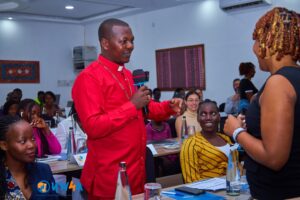
Joint planning became the foundation. WROs led awareness and training sessions on gender equality and advocacy, while religious institutions opened pulpits, congregations, and community meetings to discussions on gender justice. Young women established safe spaces, led advocacy, and demonstrated that faith and feminism can reinforce each other.
In Kenya, the National Independent Church of Africa (NICA) applied the “two-thirds gender rule” in its elections to promote more equal representation, created a young women’s department, and commissioned women as evangelists. Evangelism One Accord integrated gender justice into sermons and youth ministry, and mobilised congregations for the national march against femicide. The Seventh-day Adventist (SDA) Church in Kisii trained men on positive masculinity and elders on responding to gender-based violence.
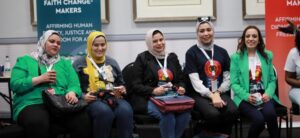
In Egypt, the Ibrahimia Media Centre worked with Al-Azhar University to develop the Women’s Leadership in Islam resource. It also launched national media campaigns linking gender justice with religious values and staged theatre productions on gender-based violence. As a trainer from the Centre put it, “When we use theatre to talk about women’s leadership in Islam, it allows young people to imagine a different future.”
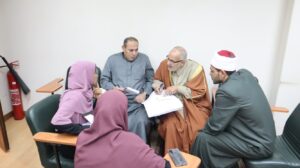
In Palestine, the Evangelical Lutheran Church in Jordan and the Holy Land (ELCJHL) convened Christian leaders across denominations, bringing Sharia and ecclesiastical judges into joint safe-space sessions for the first time. This led to a memorandum of understanding with the Palestinian Judicial Institute, integrating ecclesiastical courts into national judicial training.
In South Sudan, the Christian Agency for Peace and Development coordinated a network of five major faith institutions, including the South Sudan Islamic Council and the Presbyterian, Episcopal, Adventist and Pentecostal churches. Together they led national masculinity dialogues, spread gender-based violence prevention messages via sermons and radio, and helped reform church structures, leading to the ordination of two women pastors.
Changing the Conversation
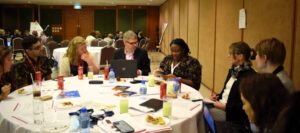
The change was evident in reforms and the words expressed by leaders where the activities took place. For example, in Meru County, Kenya, a senior pastor from NICA noted, “When we open church spaces to discuss gender justice, people begin to see the Bible not as a barrier, but as a bridge.” In Palestine, an ecclesiastical court judge and a legal officer both reflected on how unprecedented collaboration is transforming women’s access to justice. Meanwhile, at a national men’s conference, a South Sudanese imam affirmed, “Positive masculinity is not against Islam; it is part of Islam.”
“When we use theatre to talk about women’s leadership in Islam, it allows young people to imagine a different future”.
Trainer from the Ibrahimia Media Centre, Egypt
Lasting Change and Lessons
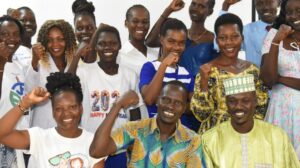
Through these joint efforts, YW4A has supported 27 faith institutions in adopting Gender Action Plans, engaged over 13,500 young women in leadership and advocacy, and engaged over 1,000 men and boys in positive masculinity sessions. These commitments are anchored in constitutions, judicial curricula, and teaching materials, with some institutions allocating their own budgets for this. Safe spaces led by young women have become part of everyday community life.
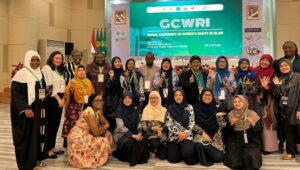
YW4A shows that when faith leaders and feminist organisers act together, they can drive lasting changes. Trust and shared agendas made it possible to link scripture with rights, giving young women authority in both religious and civic spaces. What began as two worlds moving in parallel is now a joint movement reshaping laws, norms, and leadership.
Consortium Partners
The consortium is led by World YWCA—which also provides technical support—in partnership with Equality Now, Faith to Action Network, and KIT Royal Tropical InstituteThe in-country partners include:
Egypt, Women’s Rights Organisations: Egyptian Foundation for Family Development, Farah Foundation, Sabaya Al Khair, Egyptians Without Borders, Blooming Rose; FBO – Ibrahimia Media Centre.
Kenya, Women’s RIghts Organisations: YWCA Kenya, YWCA Meru, YWCA Kisii, Inua Mama Mjane, CECOME, Safe Engage Foundation; FBOs – NICA, NEOA, SDA Kisii.
Palestine, Women’s RIghts Organisations: YWCA Palestine, YWCA Jerusalem, PSCCW, Al Harah Theatre, Aysheh Association; FBO – ELCJHL.
South Sudan, Women’s RIghts Organisations: YWCA South Sudan, YWCA Juba, YWCA Mundri, SHWDO; FBOs – CAPaD, SSIC, PCSS, ECSS, SDA, Pentecostal Church.