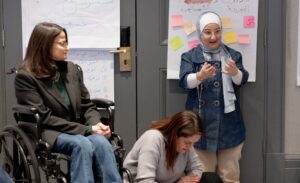


Since 2021, FemPawer has brought together feminist activists and young women across Lebanon, Jordan, Palestine, and Tunisia. Rooted in shared feminist values and a joint commitment to advancing women’s socio-economic rights, our consortium has worked with 38 partner organisations representing structurally marginalised communities to co-create more inclusive, locally-relevant understandings of economic gender-based violence (EGBV) in contexts of repression, crisis, and conflict. The programme is grounded in transformative feminist leadership (TFL) principles and practices.
TFL is a political approach that reimagines how leadership is understood and practised within feminist movements. Since adopting it as a guiding framework, the programme has gained clarity and momentum, with a sharper focus on its four pillars: Purpose, Power, Principles, and Practice. FemPawer consortium partners have embraced new leadership styles, developed practical tools, and experimented with more collaborative, feminist ways of working.
To ensure theory becomes action, FemPawer developed a Lobbying and Advocacy Training Resource on EGBV, designed to build confidence in both the concepts and practice of feminist leadership. It is already helping partners embed new approaches across their work.
One partner shared:
“Through the training we received, we modified the methods of designing campaigns and made them more intersectional with women’s rights from a gender and human rights perspective”.

Workshop participants are now passing on this knowledge through their own sessions with local organisations and young activists. This transfer of skills, networks, and leadership is already strengthening FemPawer partners’ reach and deepening impact for marginalised women.
The following quotes highlight the diverse outcomes—policy changes, local initiatives, improved market access, and shifting perceptions around rights:
“As part of our campaign, we met with the minister of local government in Ramallah to exempt displaced persons from electricity bills. This was successful, and the amounts owed to private banks were suspended for three months.”
—Partner in Palestine
TFL has also shaped how consortium members collaborate—anchoring the consortium in a shared sense of purpose and feminist values. These principles influence not only the ethos of collaboration but also operational practices. For example, FemPawer uses a Training of Trainers model, and compensates those who take on extra responsibilities, reflecting a commitment to fairness and recognition.
FemPawer’s feminist leadership principles are widely seen as a key to its success, and are embedded in practice, not just policy.
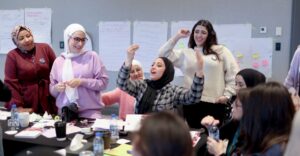
As a Lebanese participant reflected:
“What we felt, is the intentional decisions in ensuring diversity and inclusion and intersectional factors—it wasn’t just talk—there was a real focus on geographical, age, experience, background, and cultural diversity. What was amazing also is the design to ensure participation and inclusion of women with disabilities. Even survivors of violence had a large space and were engaged meaningfully and truly.”
The consortium also looked inward, confronting power dynamics between and within member organisations. Partners took risks and explored new ways of sharing decision-making. In one case, a director known for holding centralised control handed leadership of the programme to a young woman—a major internal shift reflecting genuine commitment to feminist values.
FemPawer’s success in “walking the talk” is no accident. It is the product of dedicated time, care, and attention to feminist values. While there is still much to learn, young women and structurally excluded communities have always led the way, and the collaborations, networks, and alliances that emerged over five years are stronger as a result.
“FemPawer had great strength in engaging with decision-makers. It was a cocktail—beautiful and successful—of joining all sides: community, activists, local groups, organisations, rights-holders, policymakers.”
—FemPawer Programme Coordinator