

Sara first became interested in sexual and reproductive health and rights (SRHR) during the COVID-19 pandemic, which hit Lebanon hard. Due to the ensuing economic crisis, people were, and still are, unable to withdraw their money from Lebanese banks, and her parents lost their savings. Sara was working at a pharmacy and noticed women complaining about the increasingly high price of menstrual products. After seeing NGOs reporting on the risk of gender-based violence during lockdown, she became interested in these topics.
Sara saw an opportunity to get involved in Masarouna, a five-year SRHR programme that was being implemented in the Middle East and Africa region. She joined Masarouna’s peer-learning trajectory, which convened young people of differing backgrounds and from across the region working on SRHR. Their first in-person meeting occurred in Cyprus, where they formed a team and developed a project around a problem they wanted to solve. They landed on the idea of an SRHR glossary, to address widespread misinformation about SRHR terminology. As Sara put it: ‘’Understanding the right words is the first step to knowing your right to protect your own body.’’ The team recently completed this Arabic, youth-friendly glossary.
‘’Understanding the right words is the first step to knowing your right to protect your own body.’’ – Sara
Participating in this led Sara to many new opportunities that greatly expanded her network. She travelled to Rwanda as part of the Masarouna youth delegation to Women Deliver. ‘’We had a session where I spoke to young people from all over the world about gender-based violence in Lebanon. I shared facts and real-life stories of women and talked about what type of strategies we can take as young people.’’
Sara received advocacy training and joined the Masarouna youth delegation to the Commission on the Status of Women in New York in March 2025. “I was really happy to be there and to represent women in Lebanon, who have faced so much during the war. In our meetings with member states, I didn’t just tell them statistics. I told them real-life stories. What pregnant women faced in war, how they were displaced, how they did not have access to menstrual health products.’’ For her, the key moment was Masarouna’s event as part of the NGO Commission on the Status of Women forum. She reflected on how meaningful it was to be heard by people from around the world.
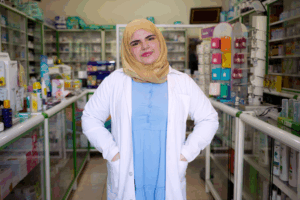
Reflecting on Lebanon, Sara noted that while war’s effects may be less visible in Beirut, they are deeply felt in the suburbs where her loved ones live. The instability weighs heavily on her, her peers, and Masarouna’s work. Moved by the displacement and bodily autonomy violations women faced—relocating from homes to schools to tents—she began looking for ways to help. Today, she leads a youth research team in Lebanon and Gaza investigating these violations and how to prevent them.
This collaboration has not been easy; on the contrary. “How can the young people we’re working with in Gaza go and ask a woman about bodily autonomy violations while they themselves are facing starvation and genocide?” she asked. Despite the challenges, they have interviewed 20 people and will produce a report with their findings.
‘‘Before the peer-learning trajectory, I was quite shy to talk about gender-based violence or period poverty. But we were motivated to talk about our experiences. I learned a lot and gained confidence to speak up and that speaking up helps others too.’’ – Sara
Sara feels that she has gained a great deal from her Masarouna journey. ‘‘Before the peer-learning trajectory, I was quite shy to talk about gender-based violence or period poverty. But we were motivated to talk about our experiences. I learned a lot and gained confidence to speak up and that speaking up helps others too.’’
By participating in the peer-learning trajectory, receiving advocacy training and participating in international conferences, she developed a strong network of SRHR advocates and organisations in Lebanon and beyond. She feels a responsibility to share her newfound SRHR knowledge with other young people, starting by encouraging her social media community to speak out. “They can start from anywhere. They can start by writing a blog. It just needs passion and confidence to start raising awareness or talking about any SRHR topic. But at the same time, young people can’t do it alone. We need the government on our side.”
Sara and her peers are a critical part of the regional and youth-centred SRHR movement and network that Masarouna has fostered over the past five years. It is the first network of its kind and has created space for collective advocacy, enabling both the consortium and young people to navigate political complexities and influence decision-makers more effectively.